
Kopfzentrum Bielefeld
Changes in the larynx
Hoarseness and voice changes can result from swelling or changes affecting the vocal folds. Treatment depends on the findings and symptoms.
Examination and diagnosis
Persistent hoarseness should be assessed by an ENT specialist. Laryngoscopy allows assessment of the larynx and vocal folds. Further investigations may be needed.
Common changes
Reinke’s oedema
Reinke’s oedema involves fluid accumulation in the vocal folds. It is often associated with smoking or other irritants and can cause a rough, hoarse voice.
Polyps, nodules, cysts and granulomas
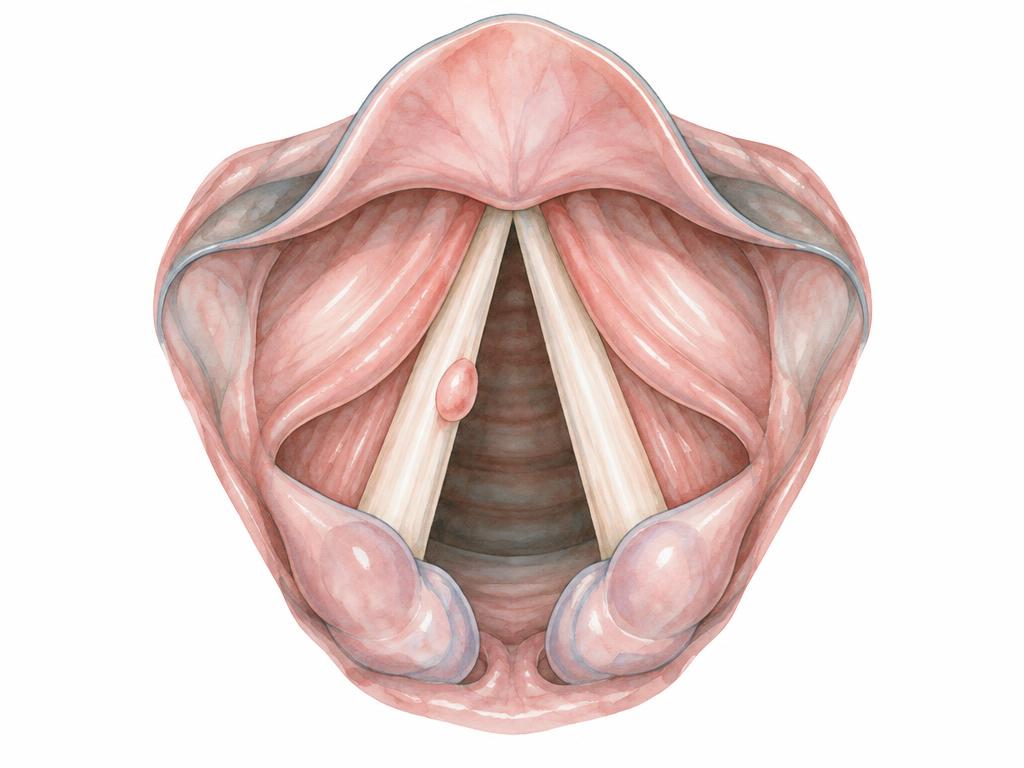
These changes differ in their causes and location. They can affect vocal fold vibration and therefore the voice. The illustration schematically shows a polyp on one vocal fold.
Papillomatosis
Laryngeal papillomas are associated with human papillomavirus (HPV). They can recur and, in rare cases, affect breathing. Treatment and follow-up require specialist care.
Treatment options
Nonsurgical treatment
Depending on the findings, voice therapy and avoiding irritants or vocal overuse may be helpful. Suitable measures are determined individually.
Surgical treatment
Surgical treatment may be appropriate for selected changes. The approach depends on the type, size and location of the finding. The aim is to treat the change while preserving vocal fold function as far as possible.
Follow-up and voice
Medical follow-up monitors healing. Depending on the findings, additional voice therapy may be helpful. Guidance on voice use and further aftercare is discussed individually.