
Kopfzentrum Bielefeld
Otosclerosis
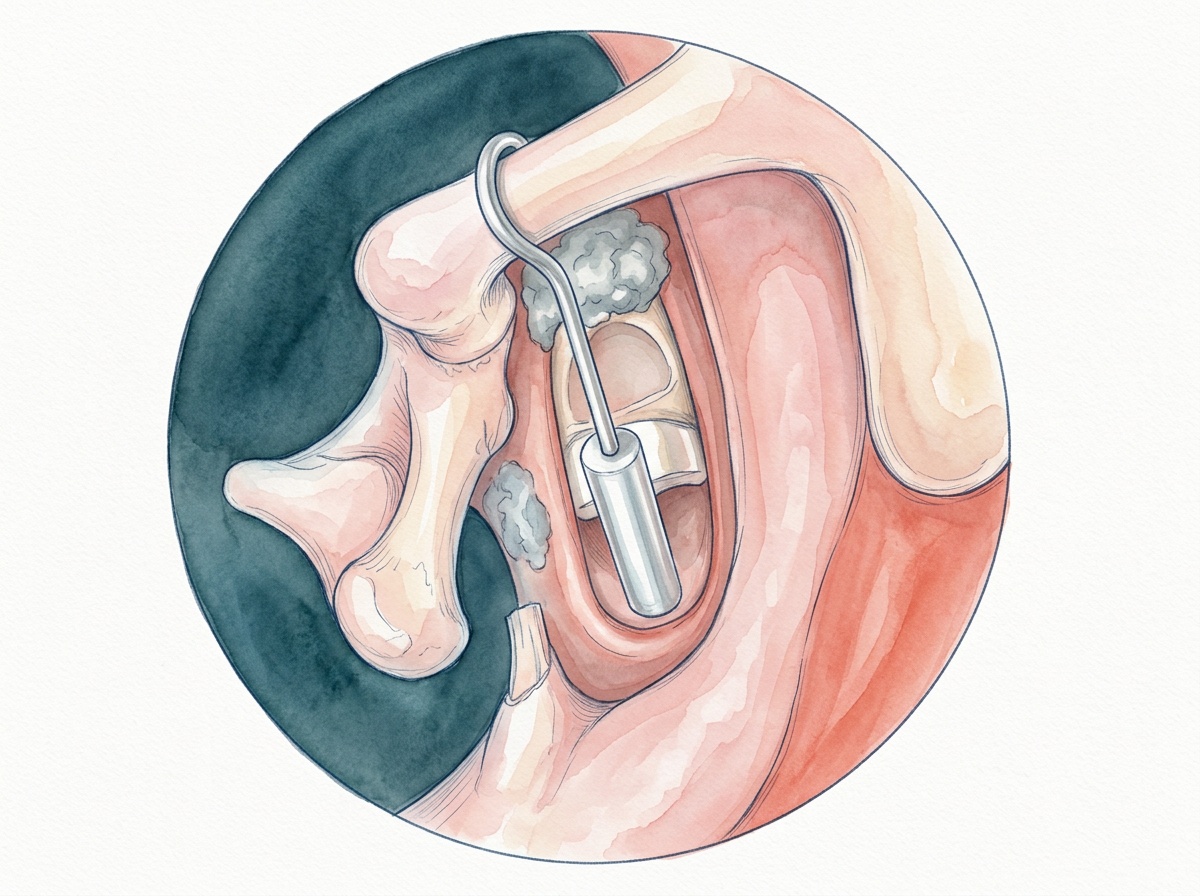
Otosclerosis is characterised by ossification and stiffening of the ossicular chain, particularly around the stirrup bone (stapes). This can lead to mixed hearing loss (conductive and sensorineural hearing loss). Typically, it is a purely conductive hearing impairment that responds well to surgical treatment.
Treatment options
Treatment (stapesplasty or stapedotomy): A small incision at the entrance to the ear canal with opening of the eardrum. Exposure of the ossicular chain and confirmation of fixation of the stapes. Removal of the superstructure of the stapes, drilling of an opening in the stapes footplate (stapedotomy) or partial removal (stapesplasty). Insertion of a hearing prosthesis to transmit sound from the incus to the inner ear. Under local anaesthesia, improvement in hearing can be checked directly during surgery; under general anaesthesia, this is only possible after the operation.
Procedure
Otosclerosis treatment: Removal of sutures and packing after approximately one week. After a few more weeks, the ear canal has healed sufficiently and hearing is generally significantly improved. After 4–6 weeks, no changes to the eardrum are visible and hearing has generally returned to normal. Otosclerosis surgery offers a successful way of treating conductive hearing impairment.
Benefits and risks
The prospects for improved hearing are very good, often better than with a hearing aid. Residual risks: reduced hearing in 1%, with a higher risk in revision surgery; deafness can occur in approximately 0.5% of patients undergoing surgery. Despite the residual risks, the operation generally enables patients to hear significantly better.
After the procedure
Even with the packing still in place, the patient may hear better immediately after the operation. Swelling in the ear canal and eardrum and the accumulation of secretions in the middle ear last 3–4 weeks. The full improvement in hearing can be confirmed by a hearing assessment.
Reasons for treatment
Improving hearing: The primary surgical treatment of otosclerosis (stapedectomy or stapedotomy) aims to replace the fixed stapes with a prosthesis, improving sound transmission and allowing hearing to be partially or fully restored.
Preventing further hearing damage: Without treatment, otosclerosis can progress and lead to further hearing loss. Early intervention can slow or stop this process.
Improving quality of life: Hearing loss can impair communication and cause isolation and psychological problems such as depression and anxiety. Improving hearing can improve social interaction and therefore quality of life.
Fitting hearing aids: Where surgery is not possible or not desired, hearing aids can be fitted to improve hearing. This is particularly important for facilitating participation in social life.