
Kopfzentrum Bielefeld
Salivary gland treatment
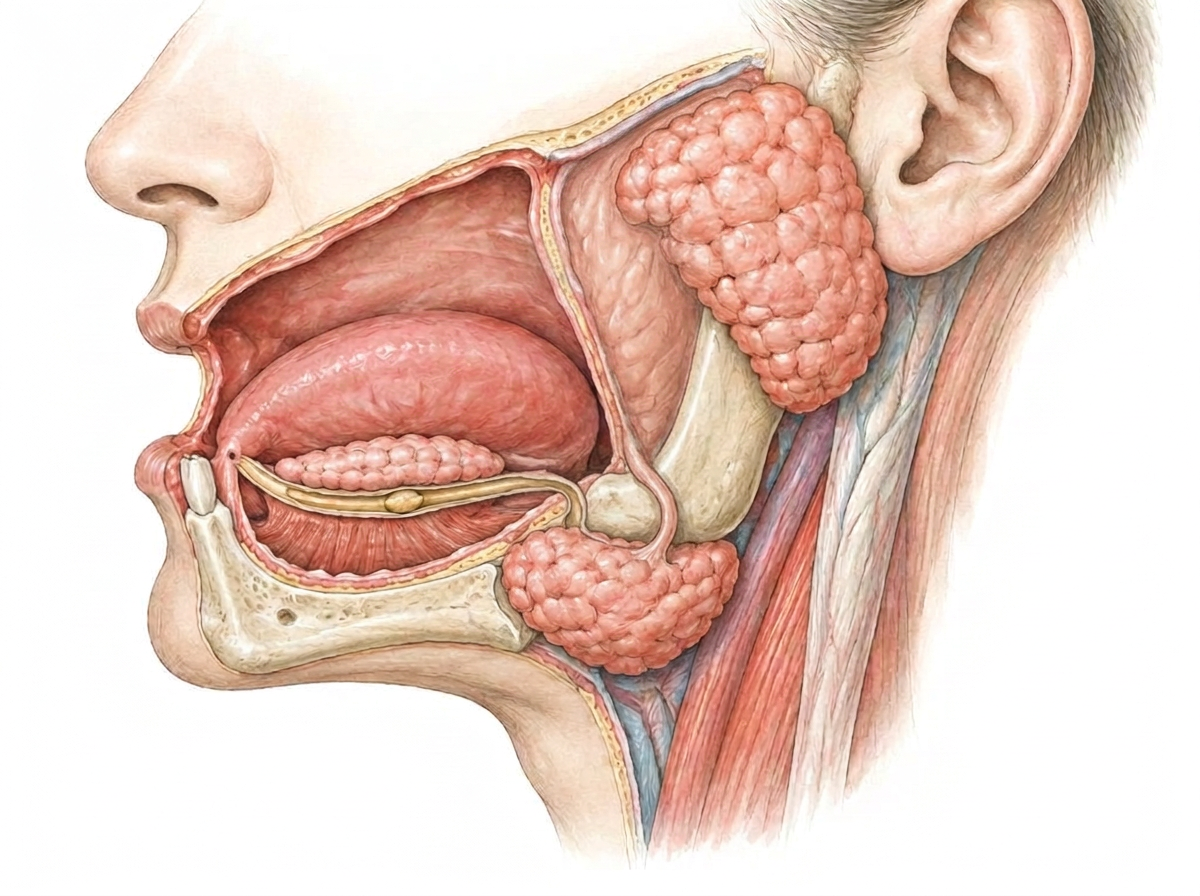
Salivary glands produce saliva, which moistens the lining of the mouth and supports digestion. The major paired glands are the parotid, submandibular and sublingual glands. Many smaller glands are found in the lips, cheeks and palate.
Symptoms and causes
Inflammation
Painful swelling may indicate inflammation. Possible causes include infections or impaired saliva drainage. Repeated inflammation can cause lasting gland damage; the appropriate treatment depends on the cause.
Stones and narrowed ducts
A stone or narrowing in a salivary duct can obstruct saliva flow. Pain and swelling may occur, particularly during meals. The illustration schematically shows a stone in the submandibular duct.
Lumps and tumours
Benign or malignant tumours can also cause swelling. A new or persistent lump should be assessed by a doctor, even if it is painless.
Examination and diagnosis
The assessment covers symptoms, their course and possible triggers, followed by examination of the mouth and salivary glands. Ultrasound helps assess stones and changes in the gland or its ducts. Depending on the findings, further investigations such as MRI, CT or tissue sampling may be needed.
Treatment options
Treating inflammation
Depending on the cause, adequate fluids, gentle gland massage and measures that stimulate saliva may support drainage. Antibiotics may be needed for a bacterial infection. Suitable measures are determined after examination.
Restoring saliva drainage
Gland-preserving procedures may be suitable for selected stones or duct narrowings. Sialendoscopy examines the duct with a thin endoscope and may also be used for treatment, depending on the findings. The choice of procedure depends, among other factors, on the location and size of the stone.
When is surgery needed?
Gland removal may be necessary for certain tumours or persistent symptoms despite other treatments. Recurrent inflammation does not automatically mean the gland must be removed. For tumours, safe treatment takes priority; tissue and nerves are preserved wherever medically possible. Risks depend on the affected gland and the findings.
Follow-up
Follow-up assesses healing and saliva drainage. If tissue was removed, the pathology findings are discussed. Further reviews depend on the condition and the procedure performed.