
Kopfzentrum Bielefeld
Eustachian tube balloon dilation
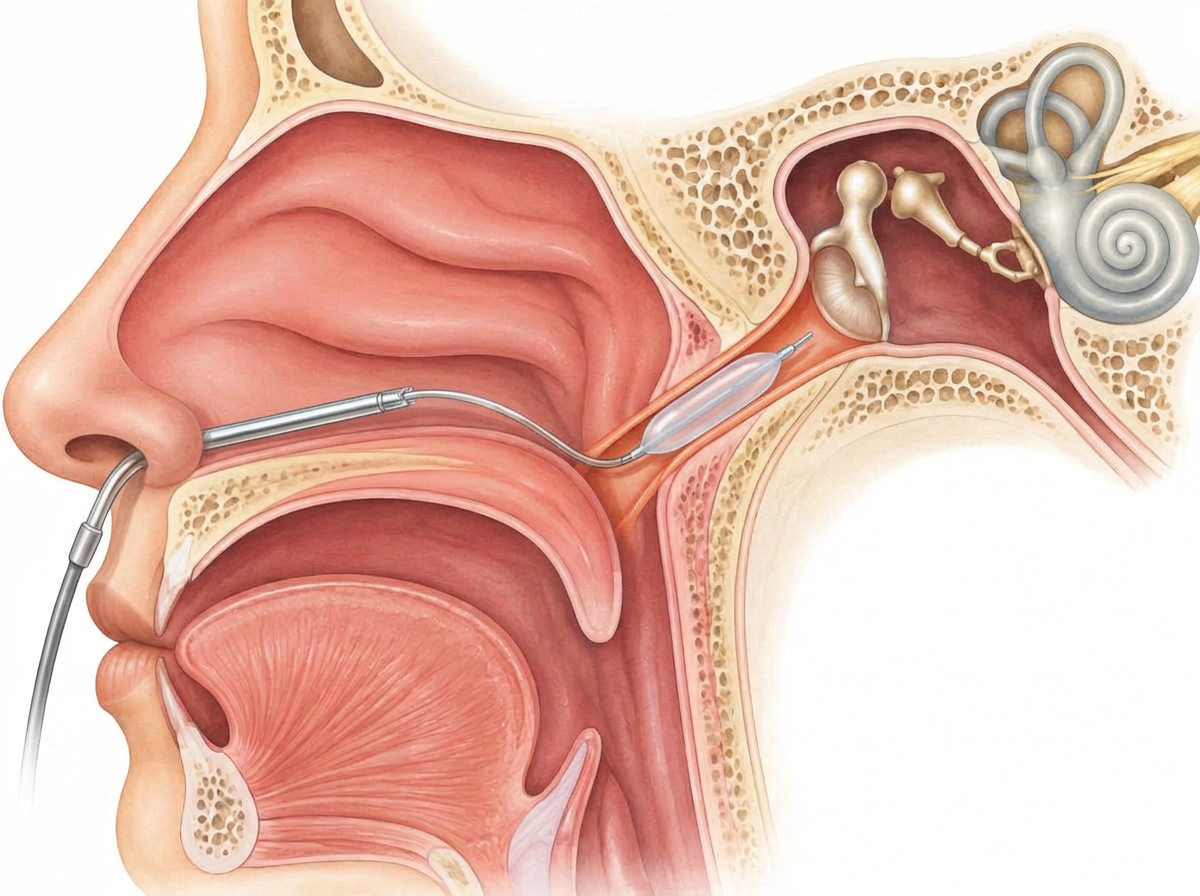
The Eustachian tube connects the middle ear to the nasopharynx. It equalises the pressure in the middle ear, protects it from secretions and noise and drains secretions away. If the tube remains persistently blocked, a feeling of pressure develops in the ear, hearing sounds muffled, and recurrent middle ear infections or fluid behind the eardrum occur. With tubendilatation, the Eustachian tube is widened endoscopically with a fine balloon catheter; tube augmentation covers surgical procedures that surgically support the opening and valve function of the Eustachian tube.
"I developed both procedures." – Prof. Dr. med. Dr. rer. nat. Holger Sudhoff
When are the procedures considered?
Eustachian tube dysfunction is usually treated conservatively at first, for example with decongestant measures, nasal sprays or pressure-equalisation exercises. If a feeling of pressure, impaired ventilation or recurrent middle ear effusions persist over a longer period despite this treatment, it is assessed whether an operation makes sense. This includes ear microscopy, a pressure measurement of the middle ear (tympanometry), nasal endoscopy and, if necessary, a test of tube function. Surgery is only considered if a persistent tube dysfunction has been confirmed and is planned individually.
Course of tubendilatation
Tubendilatation is usually performed under short general anaesthesia. Access to the tube opening is gained through the nose with an endoscope; via a fine guide catheter, a balloon is introduced into the cartilaginous section of the Eustachian tube and inflated there for a short time at a defined pressure. The balloon and catheter are then removed. The procedure can usually be performed on an outpatient basis; the preliminary examination provides the details.
Risks and aftercare
As with any procedure, this carries risks that are discussed in detail during the pre-operative consultation. Possible effects are temporary complaints in the nose and ear area, minor bleeding or a temporary impairment of tube function; injuries to surrounding structures are less common. Data on the long-term effect of the procedures are still limited; professional societies list balloon dilation as a procedure with documented safety, while the lasting benefit continues to be studied. We discuss benefits and alternatives individually. After the procedure, ventilation and hearing are monitored; aftercare is planned individually.