
Kopfzentrum Bielefeld
VOIS vocal fold implant
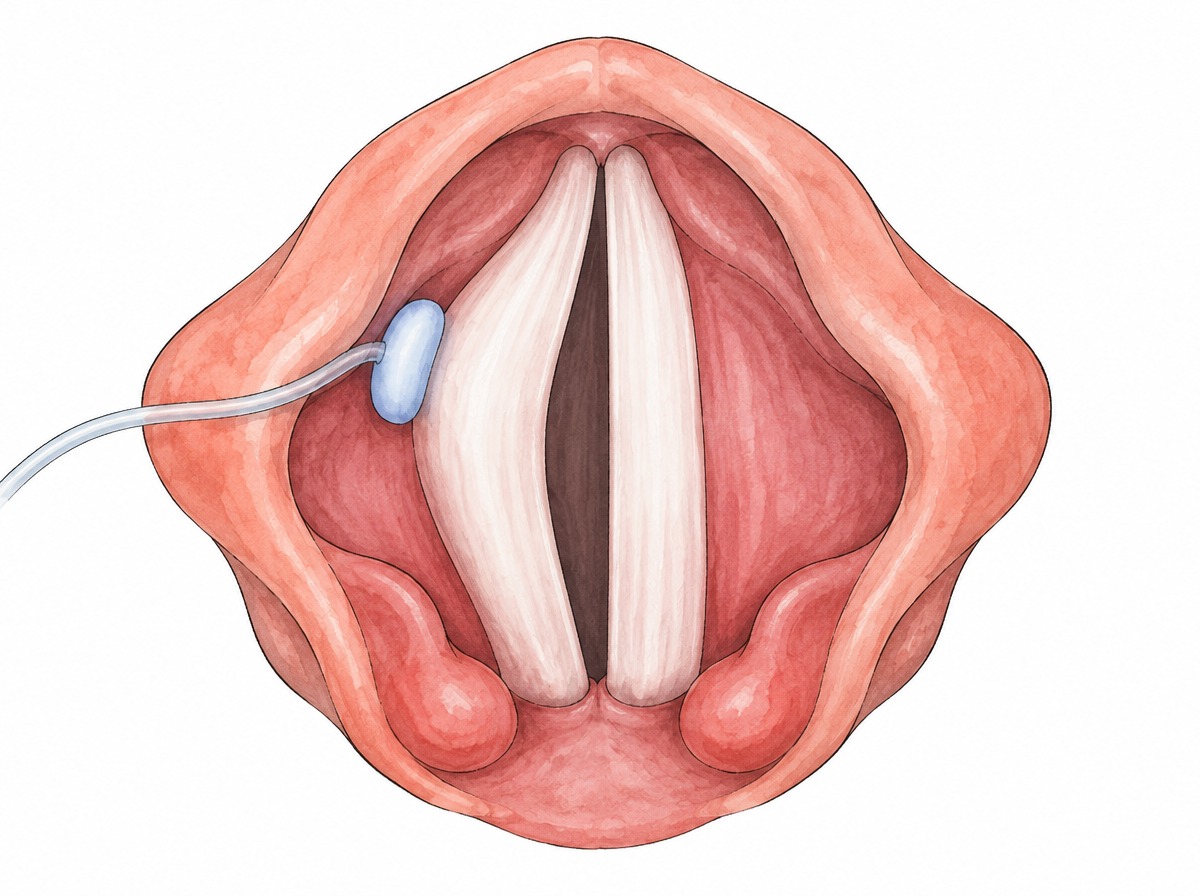
The VOIS implant is used when a vocal fold cannot move fully towards the midline, for example in unilateral vocal fold paralysis. It supports the tissue from outside, and its effect on voice quality can be finely readjusted.
Symptoms
Typical signs are a hoarse, breathy or quiet voice, voice fatigue soon after starting to speak and frequent throat clearing. Because the vocal folds do not close completely, air escapes when speaking and swallowing, and occasionally food or liquid is swallowed the wrong way.
Diagnosis
The position and mobility of the vocal folds are assessed by laryngoscopy. Measurements of the voice and of the laryngeal muscles can show whether nerve conduction is impaired and how the two vocal folds relate to each other.
Treatment
In the VOIS procedure, a silicone cushion is placed into the laryngeal framework through a small external approach. It positions the paralysed vocal fold towards the midline and thereby improves glottic closure. Through a fine tube, the filling of the cushion can be altered after surgery until the voice quality suits the patient.
After the procedure
Voice quality is reviewed at follow-up examinations and readjusted if necessary. Speech and language therapy supports the change in voice.