
Kopfzentrum Bielefeld
閉塞後の耳管再開通術
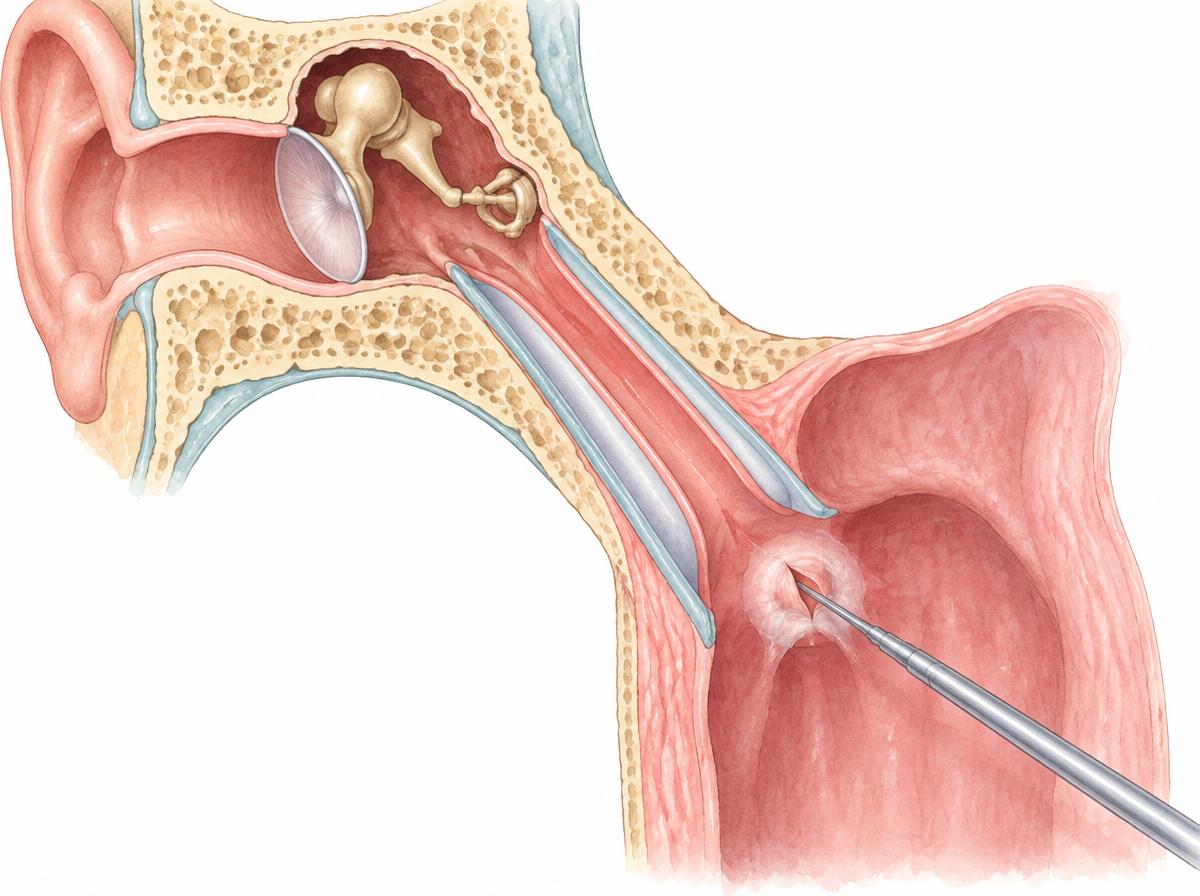
Obliteration means that the Eustachian tube is permanently occluded, for example by scarring after surgery or radiotherapy. This can impair middle ear ventilation and lead to fluid behind the eardrum. Surgical reopening (recanalisation) may be considered in selected cases. It differs from balloon dilation of a narrowed tube that still has a passage.
Assessment and treatment planning
Before treatment, the cause and location of the obstruction and the condition of the middle ear are assessed. This includes ear examination, hearing tests and endoscopic assessment of the nasopharynx; further investigations depend on the findings. Benefits, risks and alternatives, such as middle ear ventilation with a ventilation tube, are discussed individually.
Surgical reopening
In the publication linked below, Prof. Holger Sudhoff describes endoscopic laser reopening through a transnasal or transoral approach, followed by balloon dilation and temporary stenting for six weeks. One case used a transtympanic approach. The procedure depends on individual anatomy and previous treatment; it is not a standard treatment for every Eustachian tube disorder.
Results, risks and follow-up
The retrospective study included four patients. At ten to 24 months, three of the four treated ears had no middle ear effusion and tube patency had been restored. No surgical complications were reported in this small series; this does not establish a general success rate or an absence of risk. Potential risks include bleeding, injury to adjacent structures and recurrent scar-related closure. Follow-up assesses patency, middle ear ventilation and hearing.
医学的参考文献
- Sudhoff H. Permanent occlusion of the Eustachian tube: a retrospective study on reopening procedures. European Archives of Oto-Rhino-Laryngology (2024), 281:1693–1700. DOI: 10.1007/s00405-023-08271-8
- PubMed: Permanent occlusion of the Eustachian tube: a retrospective study on reopening procedures (PMID 37847285)