
Kopfzentrum Bielefeld
Carotid body tumour surgery
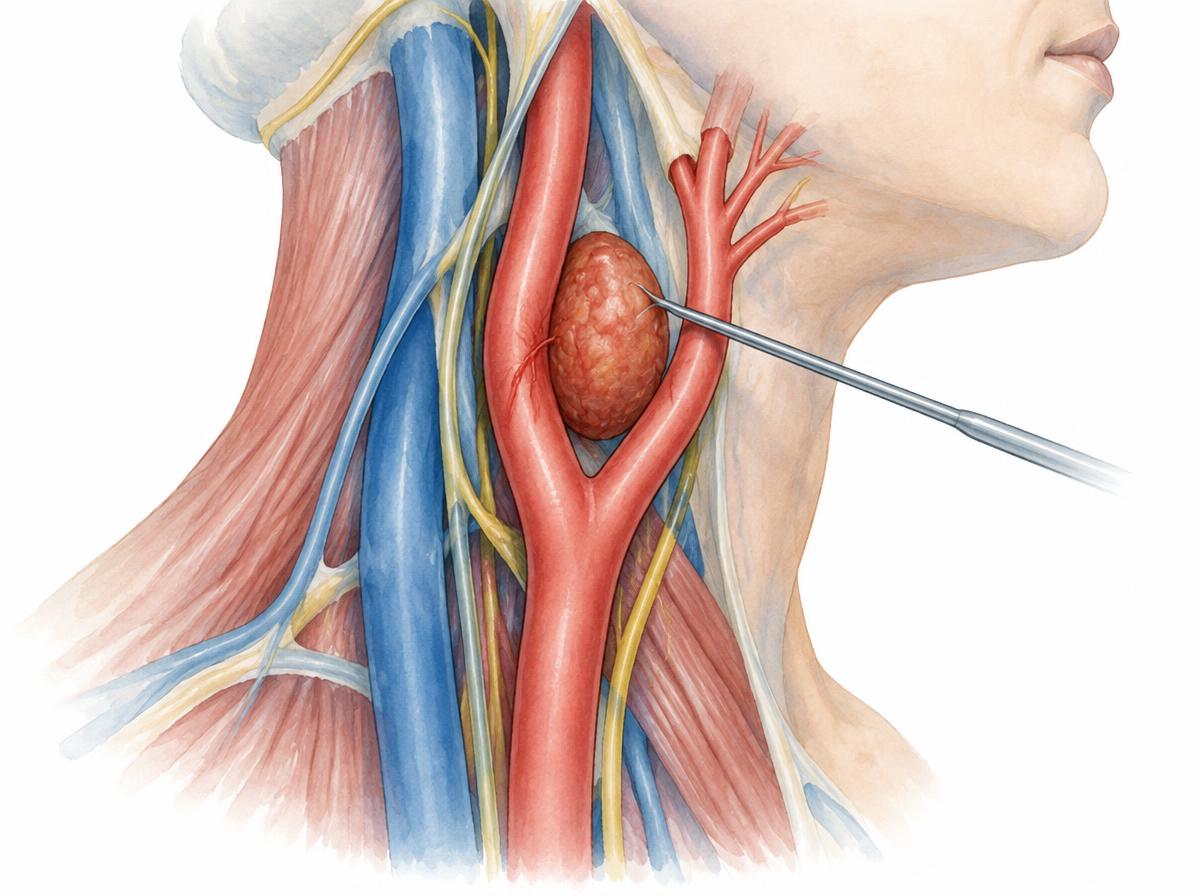
The carotid body is a small tissue nodule at the point where the common carotid artery divides into its internal and external branches. Very rarely a carotid body tumour (carotid bifurcation paraganglioma) develops there: a slowly growing, usually benign but very vascular tumour that pushes the two vessels apart. The operation removes the tumour and carefully separates it from the carotid arteries and the surrounding nerves.
When is the operation performed?
The usual reason is a palpable, usually painless nodule at the carotid artery, which is assessed further with ultrasound and extended imaging such as magnetic resonance or computed tomography. Because these tumours grow slowly, observation with regular check-ups can also be an option. Whether and when an operation makes sense depends on size, growth, location and the results of the preliminary examinations, and is planned individually.
Course of the procedure
The operation is performed under general anaesthesia through a skin incision on the neck. After the vessels have been exposed, the tumour is dissected from the inner and outer walls of the carotid arteries; the related nerves, in particular the vagus nerve, the hypoglossal nerve and the branches to the larynx, are preserved. With more extensive findings, reconstruction or enlargement of a vessel may be part of the procedure. We inform you about the length of the hospital stay before the operation.
Risks and aftercare
As with any procedure, this operation carries risks that are discussed in detail during the pre-operative consultation. Because the tumour is richly supplied with blood, post-operative bleeding is possible; in addition, temporary or, less often, permanent disturbances of the voice, swallowing or tongue movement can occur if nerves are affected. Rare, specific risks involving the carotid arteries are discussed individually. After the operation the wound, nerve function and blood pressure are monitored; aftercare is planned individually.