
Kopfzentrum Bielefeld
Hearing aid prescription and fitting
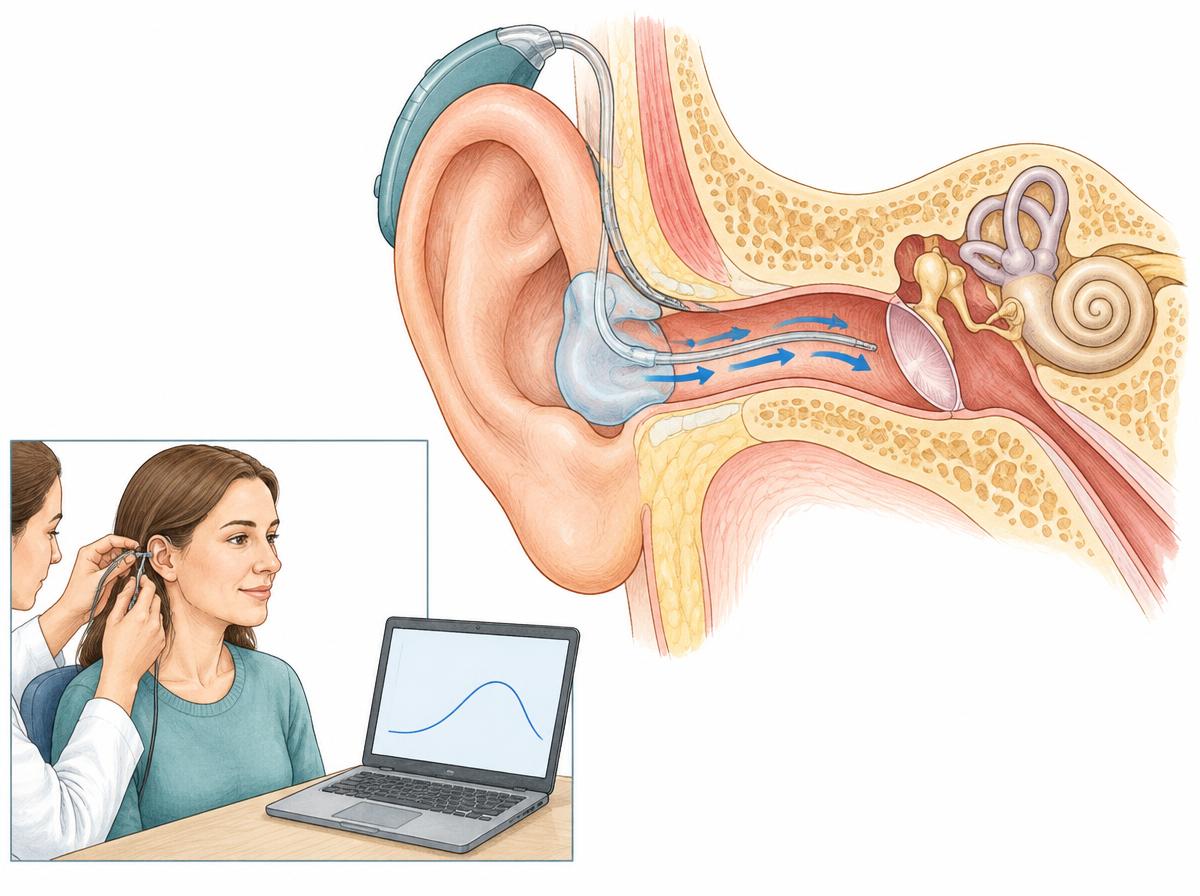
Where hearing is reduced, a hearing aid can improve hearing and understanding. Before the supply there is a medical hearing test; on its basis the prescription is issued and the device is then set individually and trialled in everyday life.
Before the supply: assessment
First the ear and eardrum are examined and hearing is measured. A distinction is made between sound reaching the inner ear only in a damped way (conductive hearing loss, usually the outer ear or middle ear is affected) and damage to the inner ear itself (sensorineural hearing loss; presbycusis is a frequent example). Depending on which part of the ear is damaged and how severely, different treatments come into consideration. If the hearing loss is temporary – for example due to a plug in the ear canal or fluid in the middle ear – the cause is clarified first.
Prescription
For supply with a hearing aid, a medical prescription is generally required, issued after the hearing test. Persons insured under the statutory system are entitled under § 33 (1) SGB V to supply with hearing aids without extra payment; alongside the device, the supply also includes services such as fitting, testing, maintenance and repair. Standard supply is bilateral. Whether and in what form costs are covered depends on insurance status and is discussed in advance.
Fitting
The fitting is carried out together with the hearing aid dispenser. Audiometric measurements are taken, the device is set individually to the hearing loss and offered for a trial in everyday life. Devices worn behind the ear (BTE) and devices sitting in the ear (ITE) are common; the design depends on the type and degree of hearing loss and on everyday demands. During fine tuning, sound can also be measured directly in the ear canal to check the setting. Several appointments are usually needed before the setting is right; checks and maintenance follow afterwards.
Limitations and further options
A hearing aid improves hearing and understanding but does not replace natural hearing. Whether and how much it helps in an individual case depends on the type and degree of hearing loss; a particular outcome cannot be guaranteed. In severe inner-ear hearing loss or deafness, a cochlear implant may be an option. If hearing aids are not sufficient in a unilateral situation, bone conduction systems are also possible. The choice of a suitable solution is discussed together on the basis of the findings.