
Kopfzentrum Bielefeld
Intratympanic injection with corticosteroid
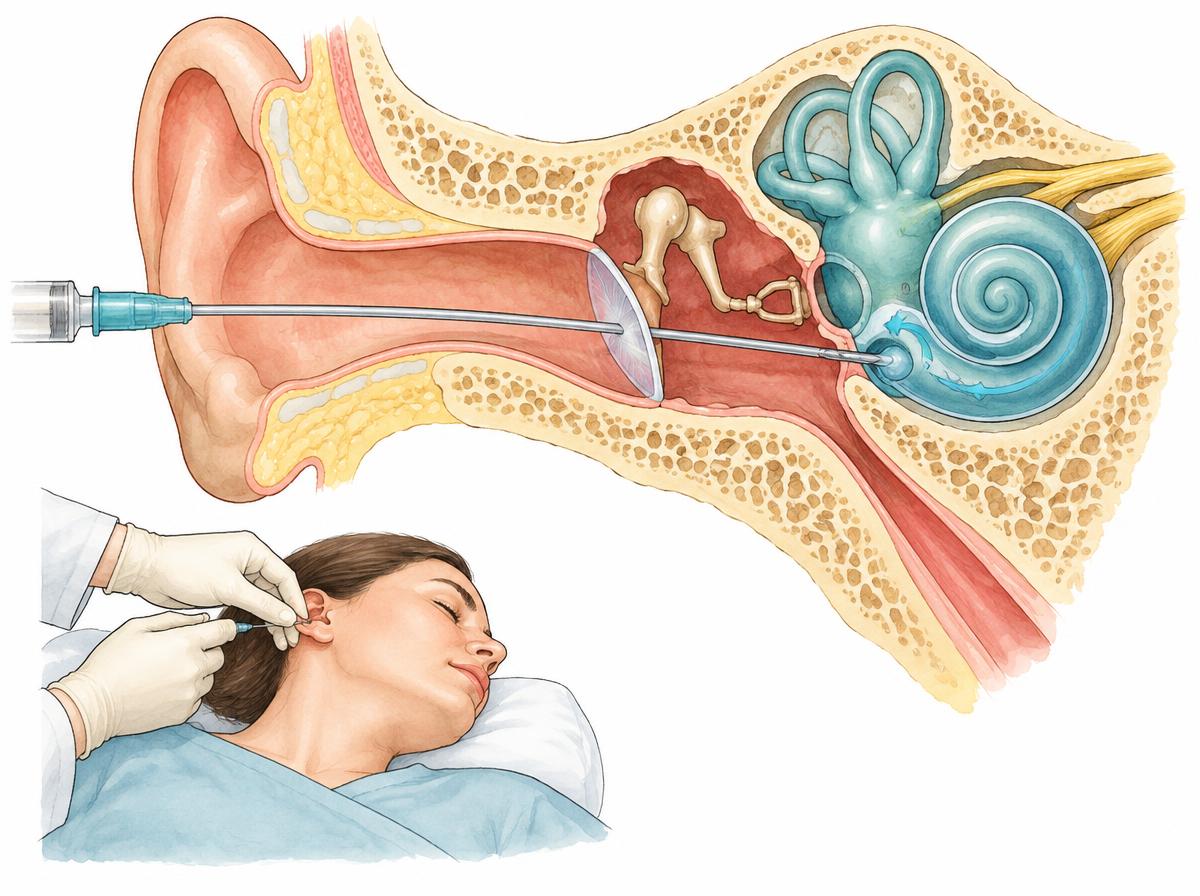
In an intratympanic injection, a medication – usually a corticosteroid preparation – is injected with a fine needle through the eardrum into the middle ear. From there it can act on the inner ear. The procedure is considered mainly when oral corticosteroids are not sufficient, not desired or not possible.
When the injection is used
The procedure is used mainly in sudden inner-ear hearing loss without an identifiable cause and in Ménière’s disease. Sudden hearing loss is regarded as an ENT emergency and should be assessed early. Whether an intratympanic injection is appropriate in an individual situation depends on the findings and the patient’s history, and is discussed in advance.
Procedure
The injection is usually carried out on an outpatient basis. The patient lies with the treated ear facing upward. The puncture site through the eardrum can be anaesthetised beforehand, for example with an anaesthetic drop. After the injection the medication remains in the middle ear for a period; for this purpose the treated side is held quietly for several minutes. Depending on findings, several sessions at intervals are possible.
Possible symptoms and risks
During and after the procedure, brief pain, a sensation of pressure, temporary tinnitus or a temporary fluctuation in hearing may occur. As with any procedure through the eardrum, the puncture site may remain open for longer or an infection may develop. Findings and possible consequences are discussed before treatment.
Assessment of effect
The advantage of the procedure is that the medication reaches the inner ear directly and is distributed less throughout the rest of the body than with tablets. Whether and to what extent hearing improves as a result is open in the individual case; review articles reach differing conclusions. A particular effect therefore cannot be guaranteed.