
Kopfzentrum Bielefeld
Laser surgical laryngeal widening according to Steiner in bilateral recurrent laryngeal nerve palsy
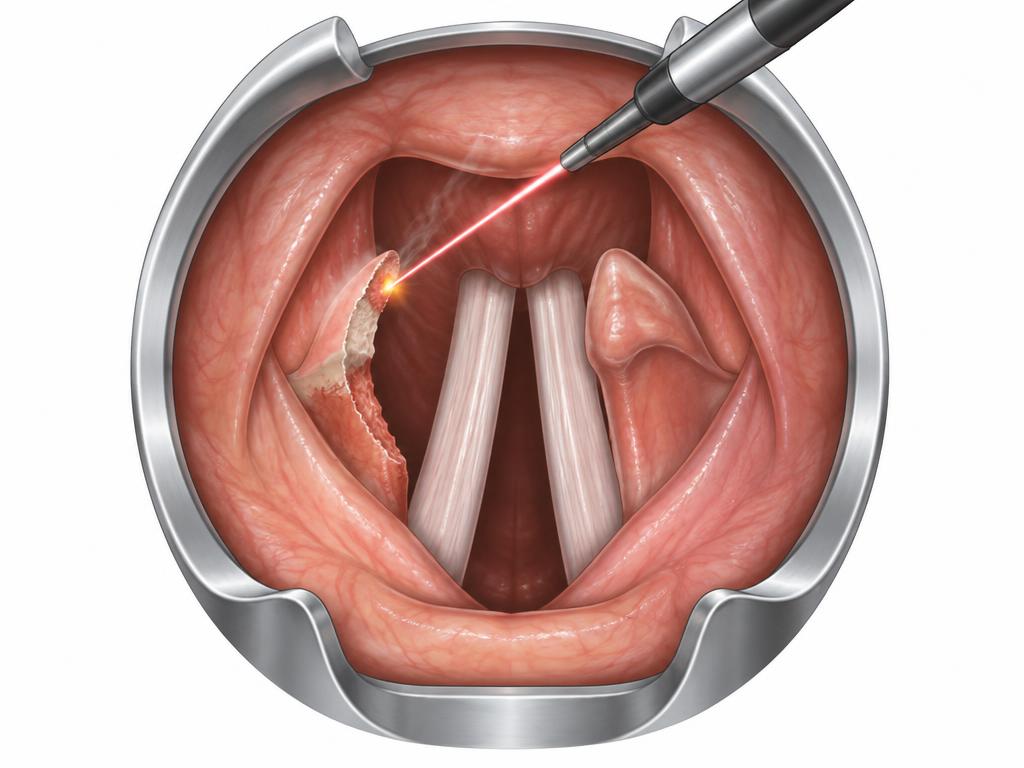
In bilateral recurrent laryngeal nerve palsy, both vocal folds are paralysed and usually lie close together in the midline. The voice is often surprisingly good, but breathing is restricted – especially during exertion. Laser surgical laryngeal widening according to Steiner uses the CO₂ laser to enlarge the airway opening in the larynx so that sufficient air can pass through the glottis again.
Aim of the procedure
The aim is safe breathing in everyday life and during exertion – if possible without a permanent tracheal cannula. To achieve this, the posterior glottis is widened in a controlled manner, typically by partial removal of one arytenoid cartilage (arytenoidectomy) or a targeted incision in the posterior vocal fold region. The procedure is performed endoscopically through the mouth using the operating microscope, without an incision in the neck.
Course of the operation
The operation is performed under general anaesthesia. The laryngeal inlet is exposed via a laryngoscope; with the CO₂ laser, tissue in the posterior vocal fold region is removed step by step. The widening is deliberately dosed cautiously, because every enlargement of the airway opening can weaken the voice. A follow-up check or a further session after healing is often advisable.
Anterior commissure
For the vocal folds to open freely, they must lie free at the anterior commissure – the anterior attachment of both vocal folds to the thyroid cartilage. If they are fused or adherent there (anterior synechia), they are divided with the laser. To prevent them from growing together again, a small plate or stent can be placed between the divided vocal folds and removed later.
Voice, swallowing and limitations
Breathing and voice are in conflict in this procedure: the wider the glottis is opened, the better the breathing, but the quieter and more effortful the voice may become. Beforehand, it is agreed together which goal takes priority. Possible risks include secondary bleeding, scarring with recurrent narrowing, temporary swallowing difficulties with aspiration, and a weakening of the voice. Whether and when an operation is advisable depends on the individual findings and is decided after thorough examination and counselling.
Medical sources
- PubMed: Endoscopic laser surgery for bilateral vocal fold paralysis
- StatPearls: Vocal Cord Paralysis (NCBI Bookshelf)
- Dennis & Kashima 1989: CO₂-Laser-hintere Kordektomie bei beidseitiger Stimmbandlähmung (PubMed)
- JAMA Otolaryngology 2013: CO₂-Laser-endoskopische hintere Kordotomie – 15 Jahre Erfahrung