
Kopfzentrum Bielefeld
Middle ear malformation – rehabilitation with atresia surgery and BAHA headband
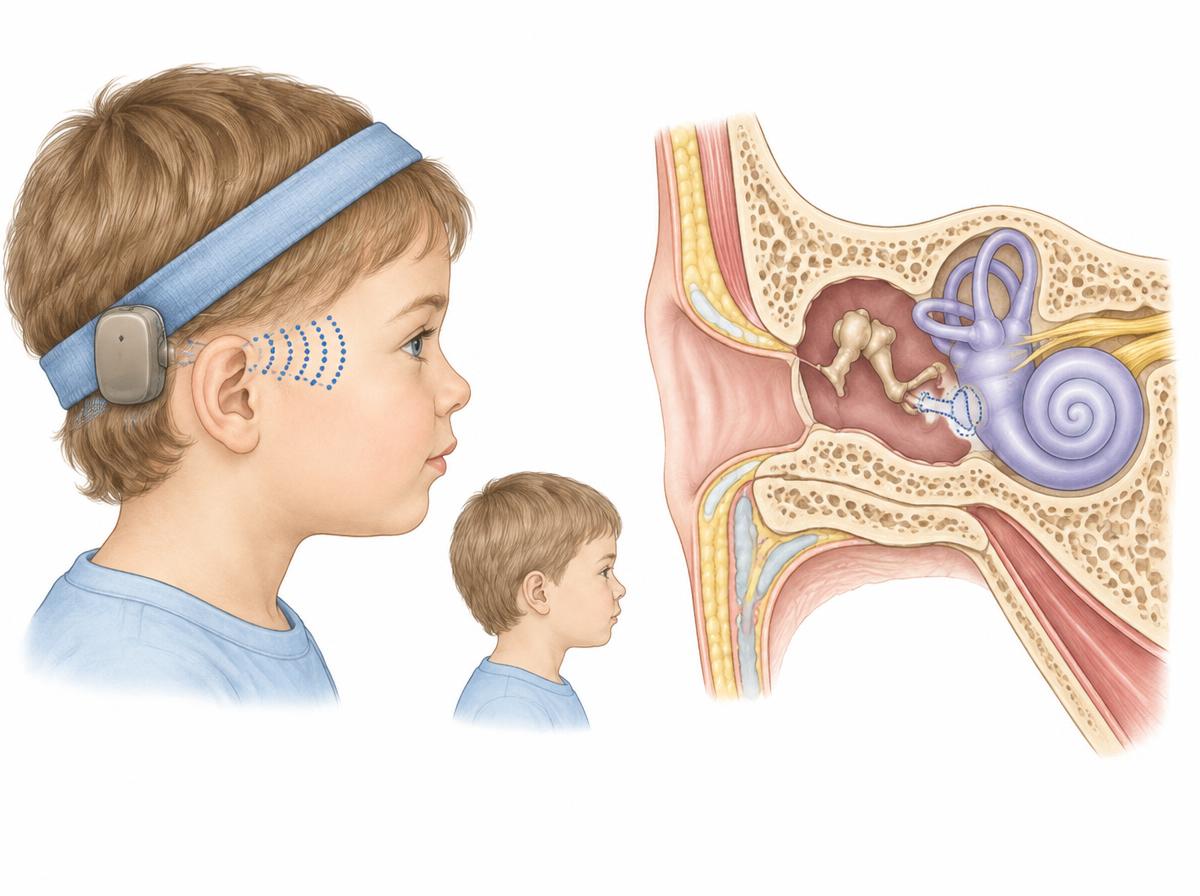
A middle ear malformation is a congenital deformity of the middle ear in which the ossicles are altered, fused or not fully formed. It can occur with an open ear canal – for example as congenital fixation of the stapes – or together with a malformation of the outer ear in which the ear canal is closed or severely narrowed (aural atresia). The result is a conductive hearing loss which, depending on severity, can be profound. In most cases the inner ear is normally developed – so the prospects for hearing rehabilitation are good.
Diagnosis
Hearing is already checked in the newborn hearing screening; an objective hearing test (BERA) confirms the degree of hearing loss. A thin-slice computed tomography of the petrous bone shows the ear canal, the ossicles and the course of the facial nerve; from this it is planned whether, and in which form, atresia surgery is possible. When both sides are affected, a hearing device is fitted early so that hearing and speech can develop normally.
Atresia surgery
In atresia surgery a new ear canal is created and sound transmission is restored by reconstructing or replacing the ossicles. The operation requires a favourable anatomy of the ear canal, middle ear and facial nerve, and is often combined with reconstruction of the auricle; the timing and sequence of the procedures are planned individually within the team.
Risks and limitations of atresia surgery
Not every ear is suitable for atresia surgery; whether it makes sense depends on the anatomy shown on CT. The newly created ear canal may narrow or close again, so that regular care and sometimes a further operation become necessary. As with any middle ear operation, there are rare risks such as injury to the facial nerve, damage to the inner ear with hearing loss or tinnitus, and dizziness. In addition, a cholesteatoma (ingrown skin) can form in the new canal, and the eardrum graft can tear (perforation) or shift outwards (lateralisation) – both may require revision surgery. The hearing result varies from person to person and may deteriorate again over time; some children still need a hearing system afterwards.
Source: Winters R, Shermetaro C. External Ear Aural Atresia. StatPearls, NCBI Bookshelf, updated 11/2025 – https://www.ncbi.nlm.nih.gov/books/NBK563257/ · Kuşçu O et al. Outcomes, Complications and Management of the Congenital Aural Atresia Surgery. Int J Otolaryngol Head Neck Surg 2014 – https://doi.org/10.4236/ijohns.2014.34031 · De La Cruz A, Teufert KB. Congenital aural atresia surgery: long-term results. Otolaryngol Head Neck Surg 2003;129:121–127 – https://doi.org/10.1016/S0194-59980300531-X
Bone conduction hearing system on a headband (BAHA softband)
Alternatively or additionally, sound is led directly to the intact inner ear: a bone conduction hearing system (BAHA) sits on a soft headband behind the ear and transmits the sound through bone conduction straight to the cochlea. This provision is possible from early childhood and can be worn without surgery; studies show that hearing can improve markedly in many children and that hearing and speech development can be supported; the individual benefit depends on the type and extent of the malformation. In bilateral malformation, both sides can be fitted.
Course and follow-up
Headband provision, hearing checks and a later switch to an implanted bone conduction system or atresia surgery are planned on an interdisciplinary basis – ENT medicine, audiology and, where needed, plastic surgery work together. Regular hearing tests document the development; with a unilateral finding, whether a headband hearing system is advisable or regular check-ups are sufficient for now is discussed individually.