
Kopfzentrum Bielefeld
Ear malformation (auricular dysplasia / microtia)
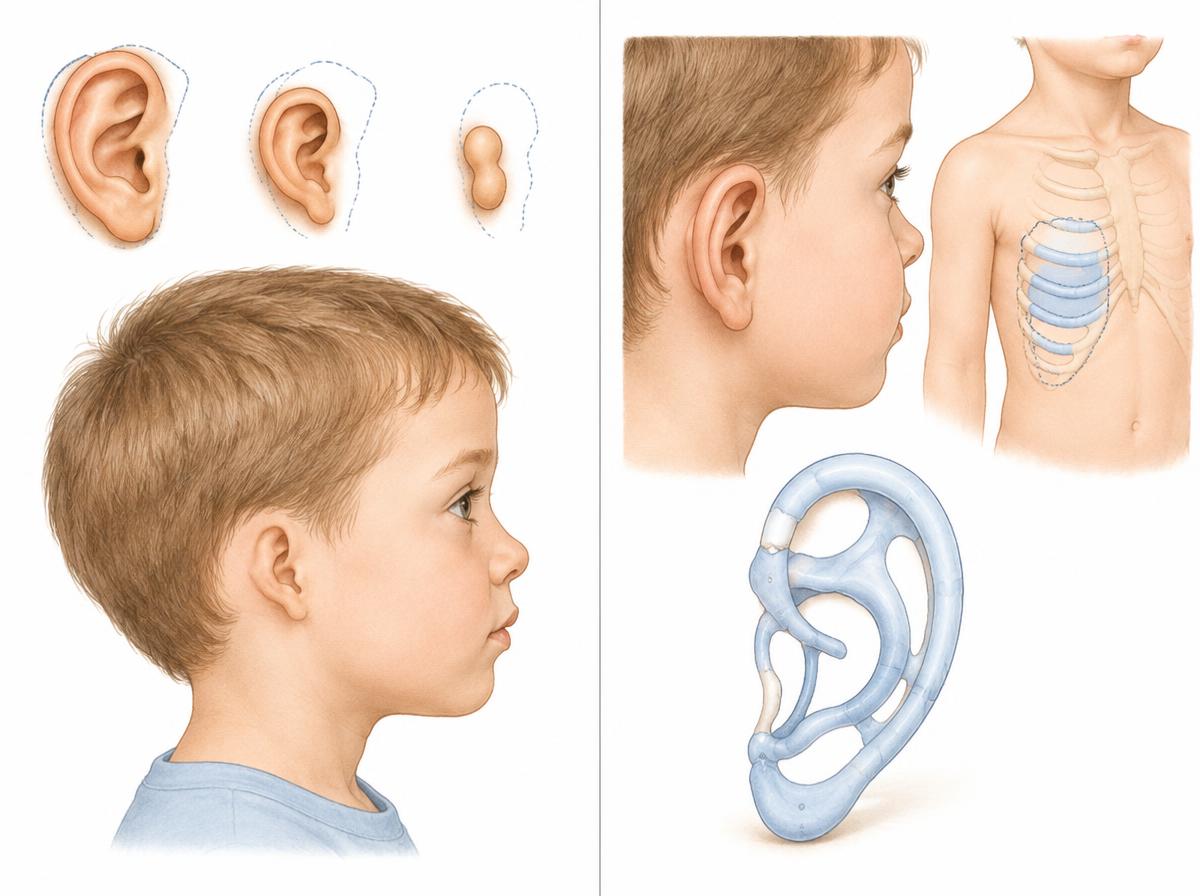
An auricular dysplasia is a congenital malformation of the outer ear: the cartilage-and-skin framework of the auricle is underdeveloped or incompletely formed. The severity ranges from slightly altered shapes to marked microtia with a small, rudimentary auricle. Frequently, the external ear canal is absent or narrowed at the same time, which leads to a conductive hearing loss; in more severe cases the middle ear is also involved.
Types
The classification follows which parts of the auricle are present: from slightly deformed but complete structures through underdeveloped ears with remnants of cartilage and skin to the absence of the auricle. What matters for treatment is not only the appearance, but also whether the ear canal, eardrum and ossicles are developed; hearing tests and imaging of the ears are therefore carried out.
Treatment options
Depending on the findings, different approaches are possible: observation and regular follow-up, bone-anchored hearing systems, a prosthetic auricle or surgical reconstruction of the auricle. Reconstruction today usually uses a framework made of the patient’s own costal cartilage or an alloplastic implant; autologous reconstructions are usually not performed before about the age of ten, because of cartilage growth. The sequence of hearing and shape reconstruction is also planned individually within the team.
Support and outlook
Children with an auricular dysplasia should be supported early and by an interdisciplinary team, so that hearing development, speech development and wellbeing are all taken into account. Care is planned appropriately for age and can proceed in stages over several years. Whether individual steps make sense, and in which order, is decided by the medical team together with the parents during treatment planning.